
Why Context Is the Real Power Behind AI: Key Takeaways from Atlassian Team ’26
Updated: May 13
At Atlassian Team '26, one theme became impossible to ignore: the future of AI at work is not just about intelligence — it’s about context.
Over the last year, the technology industry has focused heavily on large language models, copilots, and AI assistants. But at Team ’26, Atlassian shifted the conversation toward something more practical and arguably more important:
AI without context is limited. AI with context can become a true teammate.
Moving Beyond Generic AI
Most AI tools today are powerful at generating answers, summarising information, or writing content. The challenge is that they often lack understanding of how organisations actually work.
A generic AI model does not naturally know:
which project is blocked
who owns a task
why a decision was made
which Confluence page contains the latest requirements
whether a pull request relates to a customer incident
which teams are involved in a delivery milestone
This is where Atlassian’s vision becomes particularly interesting.
Rather than positioning AI as a standalone assistant, Atlassian is building AI around connected organisational knowledge.
The Role of the Teamwork Graph
At the centre of many announcements at Team ’26 was the Teamwork Graph.
The Teamwork Graph acts as a connected intelligence layer across Jira, Confluence, Jira Service Management, Bitbucket, Loom, and external SaaS platforms. It links projects, documentation, code, conversations, goals, incidents, workflows, and people into a unified graph of relationships.
According to Atlassian, the graph now contains over 150 billion objects and relationships, continuously growing as teams collaborate across connected tools.
In practical terms, this allows AI systems to move beyond simply answering prompts and begin understanding the environment behind the work.
Atlassian describes context as:
“The space in between: why a decision was made, who owns it now, what broke last time.”
That idea became one of the defining themes of the entire event.

Context Is What Makes AI Valuable
One of the strongest recurring messages throughout Team ’26 was that intelligence alone is no longer enough.
AI models are becoming increasingly powerful and accessible, but the real differentiator is rapidly becoming context: understanding how teams work, how decisions are made, and how information connects across an organisation.
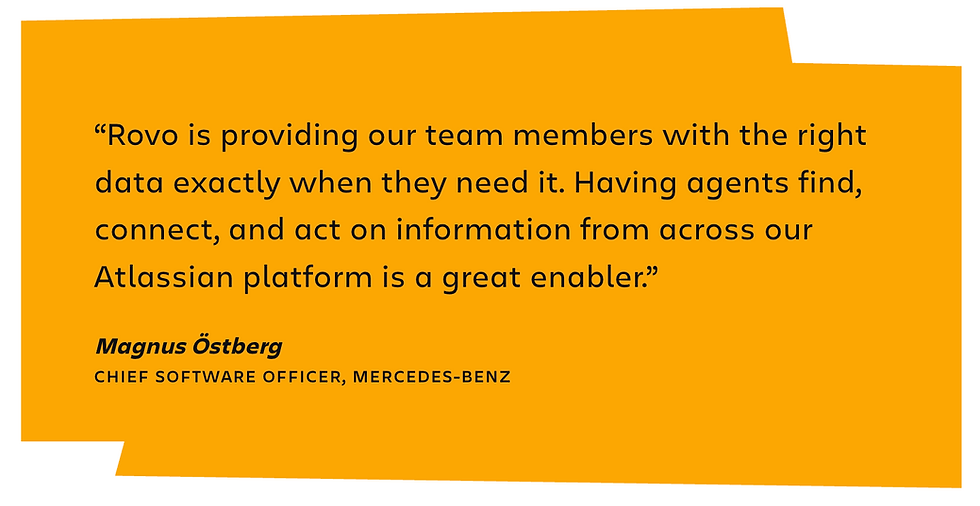
Magnus Östberg, Chief Software Officer at Mercedes-Benz AG, explained this concept through a powerful analogy:

“Why would you spend the money for a Mercedes? It's all about the smell, the sound when you close the door, the leather. The digital aspect needs to be in harmony with that. For me, that's context, and we need to put it [into the hands] of AI.”
The message reflects a broader shift happening across enterprise technology:
AI is no longer judged only by raw intelligence, but by how deeply it understands the environment it operates within.
Atlassian reinforced this throughout Team ’26 with a phrase that arguably summarised the entire event:
“Intelligence is the engine, but context is the fuel.”
This philosophy sits at the core of the Teamwork Graph — Atlassian’s connected intelligence layer designed to give AI access to organisational memory, relationships, workflows, goals, and decision-making history.
As discussed by Atlassian leaders including Mike Cannon-Brookes, Tamar Yehoshua, and Sherif Mansour, the future of enterprise AI may not be defined by who has the biggest model, but by who can provide AI with the richest organisational context.
From Knowledge to Action
One of the most significant announcements at Team ’26 was the expansion of the Teamwork Graph beyond Atlassian products and directly into external AI tools and developer workflows.
Atlassian introduced the new Teamwork Graph CLI, allowing developers to bring organisational context directly into tools such as Claude Code and Cursor.
With a single prompt linked to a Jira work item, AI tools can rapidly map:
related tasks
pull requests
requirements documentation
project owners
goals and dependencies
incident history
cross-platform relationships
The goal is to eliminate fragmented information and give AI systems access to connected enterprise knowledge in real time.
As Atlassian stated during the launch announcement:
“AI agents are only as good as what they know. Right now, most don’t know enough.”
The company argues that the issue is not the intelligence of AI models themselves, but the fragmentation of enterprise data.
Information is often:
siloed across departments
disconnected between tools
stripped of historical context
missing ownership and decision trails
This creates environments where AI can generate responses, but struggles to reason accurately about real operational work.
The Teamwork Graph aims to solve this by creating a unified contextual layer across the organisation.
AI That Doesn’t Just Answer — It Acts
Another major theme at Team ’26 was the evolution from passive AI assistants toward operational AI systems capable of participating in workflows.
Through integrations such as the Teamwork Graph CLI and Rovo MCP Server, AI systems can:
query connected enterprise data
understand dependencies between systems
update work items
trigger workflows
support incident response
surface authoritative sources of truth
coordinate actions across platforms
This represents a shift from “AI that chats” to AI that can actively support execution.
Atlassian also shared benchmark data showing that grounding AI responses in Teamwork Graph context resulted in:
44% more accurate responses
48% fewer tokens used
In practical terms:
faster, cheaper, and more reliable AI experiences.
Real-World Enterprise Impact
One of the strongest enterprise examples presented during Team ’26 came from Mercedes-Benz AG.
By building custom Teamwork Graph connectors for specialised automotive engineering systems, Mercedes-Benz connected:
defects
requirements
test cases
release workflows
engineering discussions
vehicle components
software delivery processes
into a unified contextual graph.
According to Atlassian, the results included:
90% improvement in defect intake quality
85% faster duplicate detection
10x faster software delivery
These examples highlight how connected organisational context can transform AI from a generic productivity tool into a true operational advantage.
Final Thoughts
Atlassian Team ’26 made one thing very clear:
The future of enterprise AI is not simply about generating content faster.
It is about understanding work better.
The organisations that succeed with AI will likely be those capable of combining powerful models with trusted, connected, and actionable organisational context.
And that is exactly where Atlassian appears to be positioning itself:
not just as an AI company, but as the context layer powering the next generation of teamwork.


Comments